


Babies communicate from day one – just in a very different way than we are used to. We talk to speech therapist Angelina Wagner about how parents can recognize their child's subtle signals – and why it's so valuable to look closely.
What are subtle cues in babies' early communication?
Subtle cues are signals that babies send out intuitively. For example, they show that they are hungry, relaxed or tired, or that everything is too much for them at the moment. But there are also very individual subtle cues that can vary from baby to baby. For example, my son used to get hiccups as a baby when everything around him became too much.
Are there any examples that apply to many children?
Yes, there are some commonly observed subtle cues. For example, many babies turn their heads to the side with great effort and tension when they are under stress. Many overextend themselves, i.e. show high muscle tension. Yawning or rapid breathing can also be a sign of overstimulation. Tiredness can be expressed through crying. When babies try to regulate themselves, they may bring their hands and feet to the center. Relaxed babies can have loosely open hands and establish eye contact.
So these are not just voluntary reactions?
Not at all, subtle cues are innate and intuitive. They are part of child development. For example, many babies' eyebrows turn red when they are tired. Heart rate can increase with stress. Parents usually don't even notice this.
When do subtle cues first appear?
General subtle cues can actually be observed from birth. Later, they can develop an individual character, e.g. that children rub their elbows to regulate themselves.
How can parents identify subtle cues if some of them are not even perceived?
My sister-in-law once told me that it takes a year to get to know your child. I think that's true. Parents and child first have to get into a groove. Over time, you learn to understand your child better and better. Eventually, you recognize even the smallest signals: Ah, now the baby is hungry! Or: Now it's frustrated. Parents should open themselves up to this and simply observe their baby.
Many parents are insecure at the beginning with their first child. Was it similar for you?
Yes, it was similar for me. I relied heavily on norms and tables, for example when it came to sleeping. How much should a baby sleep at this age and spread over how many naps? In retrospect, it would have made more sense to simply pay attention to my son's signs of tiredness. He communicated with me.
How did that change for you?
I eventually took a course on the early development of children. Everything was designed very mindfully, and after that, I was much better able to see my son as an individual. That way, I could see and understand him much better.
And how does that work well in everyday life?
It doesn't take much. If a baby is busy exploring the world around them, parents can simply sit next to them and observe them. This is how you get to know your child and their subtle cues very well. For example, in case of overstimulation, parents could verbalize this and say "Oh dear, everything is too much for you right now and you're very tense." This teaches the child early on that they are seen and what their current feeling means. If the baby then shows openness and willingness to interact and looks at them, they respond: "Hello, Anna! I'm your mommy. Nice to see you." It's important to smile gently and have a relaxed tone of voice. Then a short pause should follow, and the child's reaction should be awaited. This is how children learn very early on how basic interaction works.
So communication is possible that early?
Exactly. This is how children learn how an interaction works: You look at me and I talk to you and react to you. This is also important for language development and later conversations. At the same time, this gives children a great sense of self-efficacy.
So, if parents understand their baby's subtle cues, does that promote self-efficacy?
Absolutely! We must understand: Babies always want to communicate. In the first few weeks of life, this only works through subtle cues and also crying. The baby wants to communicate and show us: Hey, I need something. The subtle cues help us figure out what direction it might be going in. If parents recognize this, it is, of course, a success! The baby wanted to communicate something, the parents understood it, recognized the need, and reacted to it. Great!
Does this encourage babies to use these signals regularly?
If the signals are recognized regularly and parents respond attentively, then this is an absolute communication success for babies. Later communication attempts are also reinforced when parents respond to them. This gives them meaning. This teaches children how to fulfill their needs, repeat communication attempts, and refine them.
Is it bad if parents overlook or misinterpret subtle cues and signals?
Not at all, that's absolutely human. Sometimes subtle cues are minimal movements that parents may not even perceive. The important thing is that parents try to understand their child. You observe, interpret, make a mistake, reinterpret. With trial & error, you get better and better. And the child also feels: Someone is devoted to me and making an effort. It can even be a valuable experience if parents react imperfectly and don't correctly fulfill all needs immediately. This leads the child to the realization: There is an I and a YOU.
What exactly do you mean by that?
In the first few months, babies think they are part of their closest caregivers. They still have to understand that they are independent people. And they learn this, for example, by realizing that parents don't immediately and always know exactly what they need.
So children already understand that?
Yes, babies feel it. Generally, parents should always be aware: Babies and toddlers already understand much more language than they can produce. They also hear in the womb when you sing to them or talk to them. In the first weeks and months of life, they react particularly to the parents' tone of voice. Parents can pay attention to this when they talk to their baby. Facial expressions and gestures are also important markers for the baby at first to interpret what is being said.
Do you have any more tips for parents on how to encourage early communication with their baby?
There are many situations in everyday life that are suitable for this. For example, when changing diapers, parents can always say exactly what they are doing beforehand. Or they ask their baby: "Which arm should we put through the onesie first?" They wait briefly for some kind of reaction – that can be a small movement or just a small sound. "Ah, the right arm first." The baby is surrounded by language and feels: I am not just being dressed here, but it is happening interactively.
That's very easy to implement in everyday life.
Absolutely. Parents can also simply place their baby on their bent legs, look at them and talk to them. Take their little hands, bring them to their own face and say "I'm your mom." Such situations foster many things: bonding, language, attentiveness towards the baby. Often it is such small everyday situations that matter. Parents don't have to be perfect interpreters for every sign their baby gives. It is much more important to remain open and curious. Because with every reaction and every attempt, mutual understanding grows. Subtle cues are not rigid rules, but an invitation to connect and a wonderful way to establish genuine contact with the child early on.
You can find more scientifically sound information on early childhood development from 0–3 years, over 650 activities and much more in the mo:mo app.
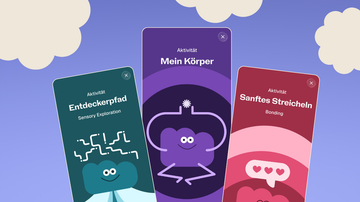
In der mo:mo App
Aktivitäten zur Selbstregulation für 12–18 Monate.
Wenn dein Kind häufig Wutanfälle bekommt, gibt es in der App 24 abgestimmte Aktivitäten, die helfen, Frustration körperlich zu kanalisieren — ohne dass es eine feste Methode braucht.
Aktivitäten ansehen