


Sudden tantrums, big emotions, and daily conflicts over trifles – many parents experience this around their child's second birthday. What's behind it? And how can children be well supported during this time? We spoke with psychologist Ceren Palik about this challenging phase.
Around 18 months, children begin to react to seemingly minor things with great anger and frustration. What exactly is happening?
Children are now discovering their own self. They have their own ideas and want to implement them – but often encounter limits: motorically, verbally, or through rules. When "I want" meets "I can't yet" or "I'm not allowed," frustration arises. And it unleashes itself.
This time is often known as the "Trotzphase" (defiance phase) in German – in English, it's called the "Terrible Twos." That sounds very negative – is it?
What looks like defiance is actually the healthy development of independence, self-confidence, and identity. For 1.5 years, children have quietly observed and watched the world. Now they want to participate, make decisions, and exert influence. This is a sign of inner growth and completely normal. This time is vibrant and challenging at the same time – for the child and for the parents. But in the end, both emerge having grown a bit. One could actually prefer to call it the "I am becoming me and that is quite exhausting for all of us" phase.
Why are children so angry so often at this age – what's going on inside them?
Children's brains are still developing. You can imagine it a bit like an amusement park that is currently under construction: The roller coaster of emotions is running: and it's running! Rapidly, colorfully, wildly. So the emotional system is already active, but the prefrontal cortex, which regulates emotions, is still under construction. This makes it difficult to deal with frustration and anger.
And what do children need then?
Simply put: They need an adult with a fully developed brain. Someone to help them cope with their feelings and learn to manage them better and better. An adult who helps them calm down with their own inner peace. This supportive guidance is called co-regulation.
What can parents do when their child is very angry? What can help, for example, if the banana breaks and the child has a tantrum because of it?
In stressful moments, we often react automatically – the way we ourselves experienced it. That can be good – or not. I recommend this image: If someone is drowning in the sea, we don't jump in after them; we stay on the shore and throw a lifebuoy. It's the same with strong emotions like anger or frustration: The child is overwhelmed by them, and at that moment, they cannot regulate themselves. What they need is not for us to go down with them or shout along, but a calm, steady hand.
So parents should throw their child a metaphorical lifebuoy?
Exactly. It doesn't always work, but you can try. Parents should try not to get swept up in the child's anger. Because then they quickly get angry themselves and everyone escalates each other. It's best to talk to the child calmly and in simple, clear words, for example: "I'm here, you're safe here." Sometimes silence is better than many words – in acute anger, hardly anything gets through anyway.
Often, you feel like children don't even perceive you anymore.
That's true. That's why it's often better to talk about it afterwards. In a calm moment, you can revisit the situation: "You were angry because the banana broke." This way, children learn to name their feelings. After a burst of emotion, I often ask my son: "Do you need love or space now?" This allows him to decide for himself whether he wants to cuddle and be held, or would prefer to just move on to something else.
That surely helps them for the future as well, doesn't it?
Yes. They learn: Feelings are okay. And you can learn to deal with them – with support. We are role models: When we say, "I'm annoyed, I'm going to take a deep breath now," children learn that even big feelings can be regulated. Playful rituals like punching a pillow to vent anger or an anger dance can also help.
Do clear boundaries help during this time, or should parents allow as much freedom as possible?
Both. Clear boundaries provide stability. Freedoms in between allow for co-creation. It is important that boundaries are not arbitrary. If the child hits, I can say: "I don't let myself be hit." At the same time, there should also be areas where the child can have a say. This way, the child experiences: "I am heard. I am effective." If parents constantly say no in everyday life, it is very frustrating for children and power struggles are the order of the day.
Back to the banana: The child is angry because it broke. Do I give them a new one? Or is it: either you eat this one or none at all?
Both are possible. First, I would put the child's feelings into words: "You don't like that the banana is broken. It doesn't look pretty now." This acknowledges their feelings. Then I can try to turn the whole thing around humorously by making a funny face: "Oh dear, the banana is so ugly now. Oh my! What shall we do? Let me try, can it still be eaten?" It's perfectly fine for this to be deliberately silly.
How can you tell if children are navigating this phase well?
First of all: anger, frustration, and defiance don't just disappear. These feelings remain. What's important is how children learn to deal with them. You can see this learning process happening, for example, when a child calms down more quickly after a tantrum and seeks contact, like holding a hand or wanting to cuddle. Later, children find words for their feelings or even their own solutions to navigate difficult situations.
How can parents regulate themselves when they feel exhausted or overwhelmed by constant conflicts?
Parents often want to do particularly well – better than they might have experienced themselves. But that can be quite exhausting. It doesn't always have to be perfect. 3 well-managed tantrums a day is already a lot. For the 4th, it's okay not to have any energy left.
In such moments, I tell my child: "I need a moment, I'll be right back." Then I step out briefly, take a deep breath, or drink a glass of water. This is honest and shows my child that even adults have limits. That's a strong role model.
In the end, all parents feel similarly.
Absolutely. But hardly anyone talks about it. I remember a situation on the tram – my child had a long tantrum and I felt helpless. And I'm a psychologist. But that's the point: these moments are human. If we were more open about it, we could learn a lot from each other and normalize such situations. Then we would see: We all go through this. Then we would also develop fewer unrealistic expectations of ourselves.
And that could help?
Definitely. Then it might not be so uncomfortable for us in public if our child is going through big emotions. And it would also help us to stay realistic and not be too hard on ourselves. Instead, plan breaks in everyday life and seek out exchanges with others. Because: No one has to do it all alone. Only those who take good care of themselves can also be there for others.
What advice would you give all parents who are currently going through this phase?
When everything feels like a single power struggle, a small shift in perspective often helps: fight less, let them co-decide more. Small shared moments are also good, laughing together, being silly, or reading a book. When the connection is strong, there's less conflict. And if you realize you're not making progress: Get support from partners, other parents, or counseling centers. It's not a sign of weakness, but of care, for yourself and your child.
You can find more scientifically sound information on early childhood development from 0-3 years, over 650 activities and much more in the mo:mo app.
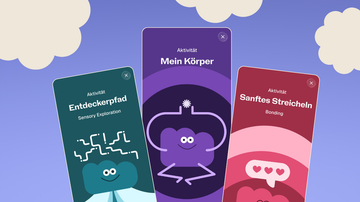
In der mo:mo App
Aktivitäten zur Selbstregulation für 12–18 Monate.
Wenn dein Kind häufig Wutanfälle bekommt, gibt es in der App 24 abgestimmte Aktivitäten, die helfen, Frustration körperlich zu kanalisieren — ohne dass es eine feste Methode braucht.
Aktivitäten ansehen