


Cold season with small children often means uncertainty: When do you even speak of a fever? How do you measure temperature correctly? And what does a child need when they are sick - medically and emotionally?
We spoke with Luisa Straub, a health and specialized pediatric nurse (for intensive care). She provides parents with the most important basics and shows them how they can reliably support their child during this challenging time.
What's the best way to take a child's temperature?
For children under one year, rectal measurement (via the bottom) is best. For older children, ear thermometers can also be used. It's best to measure both sides. If the child has been lying on one side for a long time or has worn a hat, you should wait 5 minutes. I advise against forehead or infrared thermometers, as they are too imprecise.
And when do you call it a fever?
Between 37.5 and 38.4°C is considered an elevated temperature, and above 38.5°C is a fever. An important exception: For infants under 3 months, a temperature of 38°C or higher is already considered a fever. In such cases, parents must definitely see a doctor or go to the hospital. Fever in very young babies must always be investigated. However, generally speaking, fever is not an illness but a reaction of the body to better fight off pathogens.
Which illnesses are most common in babies and toddlers during cold season?
Mainly flu-like infections, coughs, sniffles, and middle ear infections. The RSV virus is also widespread. In young children, it can be dangerous because they cannot yet cough up mucus. However, for some time now, it has been possible to vaccinate babies against RSV. RSV prophylaxis is particularly important for premature babies or infants with pre-existing conditions.
How do parents know when it's serious?
If children have difficulty breathing, that is always an alarm sign – go to the doctor immediately. Difficulty breathing is often recognizable by the nostrils moving when inhaling or the skin between the ribs being drawn in. Also, if children drink very little, their diaper remains dry, or they seem very sluggish, it is important to see a doctor. It is best for parents to offer the breast, bottle, or, for older children, drinks or soups more frequently.
What can parents do to prevent illness?
Illnesses cannot be completely avoided. But fresh air, plenty of exercise, and a balanced diet with fruits and vegetables strengthen the immune system. If desired, fruit can be hidden in freshly squeezed juice or smoothies, and vegetables in pureed sauces. Regular handwashing is also very important: after coming in and before eating. If the child has a stomach flu, parents can also use disposable gloves when changing diapers so that the whole family doesn't catch it in the end.
Daycare children are often sick. The problem often is: too healthy for home, too sick for daycare. Where do you draw the line – when should children really stay home?
I know it's a balancing act for many parents, especially single parents, when their child is frequently sick. Some children have a runny nose almost non-stop in autumn and winter. I would make it dependent on their general condition: If the child is fit, coughing a little and has a slight runny nose – then I would send them to daycare. If they are very sluggish, have a fever, or stomach flu – then they should stay home and recover.
Do parents develop a feeling for this over time?
Absolutely. A certain routine sets in even with illnesses, when things recur. Some children spike a high fever very quickly, others are prone to febrile seizures, and still others to pseudo-croup. This is frightening the first few times. But once parents have experienced it several times, they know what to expect and usually react quite routinely.
How important are closeness and comfort?
Very important. Children need a lot of physical contact, especially then. I often recommend using a baby carrier. It relieves the parents and you quickly notice if the child's fever is rising again.
Many parents are very anxious themselves in such situations.
That's normal, especially if lack of sleep from bad nights is added. It helps to ask someone for a second opinion: a partner, friends, or one's own parents. And when in doubt, it's always better to go to the doctor once too often than once too little.
What role does a well-stocked medicine cabinet play?
A big one. It's best to coordinate it with your pediatrician. Important: Store medications for children and adults separately to avoid accidentally grabbing the wrong one. That can quickly become dangerous.
Do you have another tip?
I swear by manual nasal aspirators. They can make breathing so much easier for the little ones. They generally don't like the aspirators at all, but it brings great relief. It can also help to clear the nose a bit of mucus with a tissue or a baby cotton swab. Also important for parents: when children are sick, they should not look at the rest of their development.
Because the body is busy?
Exactly. The body is fighting an infection and simply doesn't have the time or energy to invest in new developmental steps. Developmental progress often stagnates for a short period. Many children then experience a small growth spurt after the infection.
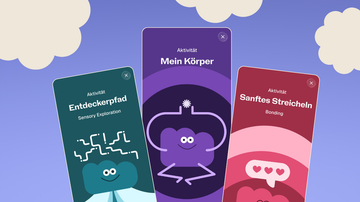
In der mo:mo App
Aktivitäten zur Selbstregulation für 12–18 Monate.
Wenn dein Kind häufig Wutanfälle bekommt, gibt es in der App 24 abgestimmte Aktivitäten, die helfen, Frustration körperlich zu kanalisieren — ohne dass es eine feste Methode braucht.
Aktivitäten ansehen