


Parenting is incredibly fulfilling – and very intense. How wonderful would it be to just take a shower in peace, eat something – or simply catch your breath? Free play can make exactly that possible. And it offers double the benefits! Not only does it give you a small break, but it also strengthens your child: creativity, imagination, problem-solving skills, and self-confidence – all of this grows when your child is allowed to try things out for themselves.
Here you will find how to guide free play, age-appropriate recommendations for duration, suitable toys, and the right environment.
What does your child need for free play? Not that much.
For independent play to work well, one thing is essential: a safe environment. That means a space where your child can explore without danger – and without you constantly having to intervene. A true yes environment.
When it comes to toys, less is often more. Instead of overstimulation, selected toys that you rotate regularly are more helpful. Small play areas in different rooms or mobile baskets ensure that your child can play near you – whether you're at the dining table or in the kitchen.
Rituals and routines help integrate free play into your daily life. And, as is often the case, the best conditions are simple: fed, safe, and connected – then they can get started.
Free play: Support, but don't take over
Children learn a lot through imitation. It can therefore be helpful to start playing together and offer initial ideas and impulses. As soon as your child is engrossed in play, you can slowly withdraw and let them do it themselves – even if they play differently than you expected. Children intuitively use objects in a way that suits their current stage of development.
And what if your child keeps calling for you? Don't worry. Independent play sometimes requires patience. But that's exactly what strengthens problem-solving abilities and self-efficacy.
Read here which toys are particularly stimulating for children of different ages and promote free play.
0-3 Months
In the first few months, playtimes are short – usually only a few minutes. A blanket on the floor, a bouncer, a playpen, or a crib are suitable safe environments.
- High-contrast black and white images and colorful, dancing mobiles attract the little ones' attention.
- Music is also a hit: music boxes or battery-operated mobiles provide extensive musical fun.
3-6 Months
Now it gets exciting – your baby discovers the world by grasping. Give them interesting toys to explore directly into their hands. You can also hang them on a play arch within their reach. This way, your baby decides what they want to play with.
Toys that appeal to the senses are particularly interesting:
- Grasping toys in different shapes and with different surfaces
- Crinkly or squeaky fabric picture books
- Contrast cards or books
- Unbreakable mirrors
Toys can not only entertain – but also enable initial cause-and-effect experiences:
- Rattle socks and bracelets also encourage kicking.
- A rattle provides a lot of fun. You can buy one or make your own: fill small plastic bottles with rice, pasta, or colorful beads and seal them securely (e.g., with hot glue). Change the rattles regularly to keep them interesting.
6-12 Months
Now your baby becomes a real explorer! They crawl, explore everything, and have endless curiosity. Even an open wardrobe or the soil of houseplants are incredibly exciting. With a few alternatives, you can guide this urge to discover meaningfully. At this age, your baby can already occupy themselves alone for 5 to 10 minutes with the right offerings.
- Discovery basket or drawer: Filled with harmless everyday objects, they invite awe, grasping, and emptying. Your baby learns about different surfaces and weights.
- Crawl tunnel: A large cardboard box with openings or a few chairs with a blanket over them provide an exciting crawl tunnel. Perfect for first adventures!
- Crawl course: Pillows, blankets, and small hills on the floor encourage crawling, climbing, and rolling, thus promoting body awareness and coordination.
- Water play: A little water on a tray or in a shallow box, a few play items like baby spoons or plastic cups, and the water play is perfect!
12-18 Months
At this age, your child can occupy themselves alone for 10 to 15 minutes. Particularly interesting: playing with everyday materials and sorting things.
- Shape sorting made easy: Shape sorting toys are a great challenge. If that's still too difficult, you can cut corresponding shapes into a cardboard box for building blocks or glass lids. This provides quick successes and increases endurance.
- Stacking & Knocking Down: Toddlers love to stack objects and then knock them down. This promotes hand-eye coordination, understanding of cause and effect, and is fun! Building blocks, stacking cubes, or stacking cups are well suited for this.
- Pound-a-peg toys and sorting games: These simple games are perfect for exploring cause & effect.
- Pushing & Pulling: With the first steps, push and pull toys become exciting – a small chair or a pull-along toy provide movement.
18-24 Months
Your toddler is bursting with imagination and loves to re-enact everyday situations. Playtimes become longer – about 15-20 minutes – and increasingly creative.
Through play, your child processes their daily life. These toys support that:
- a play kitchen or small toy food and bowls or pots
- everyday objects in child size or as toys (e.g., child's broom and telephone)
- dolls and stuffed animals with doll clothes and strollers
Washable pens and finger paints are perfect for first attempts at drawing and scribbling. This not only strengthens creativity but also fine motor skills. Threading with large beads also promotes dexterity.
Movement games can be a lot of fun: with soft play balls, your child can roll, kick, or throw. First vehicles also provide action. Don't forget the helmet!
Your child can also entertain themselves well with these:
- sturdy picture books with flaps or sounds
- first puzzles
- sorting toys
- toy cars for driving on all surfaces (clean them with a sponge afterward)
- musical instruments, e.g., a basket with a rattle, drum, or xylophone
24-36 Months
At 2 to 3 years old, your child's role-playing becomes more complex. They can already delve into an activity for 20 to 30 minutes. Sometimes, however, they need a small impulse from you: play along briefly and then withdraw.
Your child processes their daily life through re-enactment. With these toys, imagination knows no bounds:
- (Animal) figures
- Building blocks, plug-in or magnetic building blocks
- Train tracks or road sections
- Play shop
- Dress-up boxes with cloths, hats, discarded clothes, or homemade masks
·. Your child continues to experience their world with all their senses. You can support this with suitable play materials:
- Rice, lentils, or pasta and various containers like cups and spoons for pouring games
- Water play with cups, spoons, funnels, watering can, or sponge
- Mud kitchen with water, earth, and stones
- (Kinetic) sand and toy excavator
- Playdough
Your child is playing vigorously, and you're enjoying a cup of coffee? These movement games make it possible:
- Chalk obstacle course for hopping, running, or riding toys
- Bubbles with a bubble machine so you don't run out of breath
- Target practice for kicking & throwing
Your child can completely immerse themselves in creative activities:
- Crafting with colored paper, glue, stickers, pens, brushes, and paper scissors
- Coloring pages of favorite animals, dinosaurs, or superheroes
- Chalk for large works of art on the street or patio
Quiet games promote concentration and attention:
- Puzzles with favorite motifs
- Look-and-find books
Free play is an important building block for development, self-confidence, and creative unfolding. And incidentally, it creates space for small breaks in everyday family life. With a little preparation, trust, and the right amount of serenity, independent play quickly becomes a valuable part of your day. And who knows – maybe the next great pirate adventure will even unfold under the dining table.
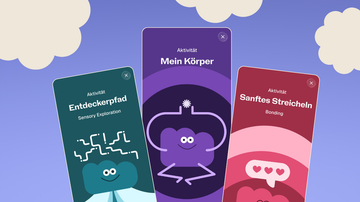
You can find even more scientifically sound information on early childhood development from 0–3 years, over 650 activities, and much more in the mo:mo app.
In der mo:mo App
Aktivitäten zur Selbstregulation für 12–18 Monate.
Wenn dein Kind häufig Wutanfälle bekommt, gibt es in der App 24 abgestimmte Aktivitäten, die helfen, Frustration körperlich zu kanalisieren — ohne dass es eine feste Methode braucht.
Aktivitäten ansehen
1 comment
Ein sehr schöner Artikel, der die ersten 3 Jahre sehr gut darstellt und Anregungen für die Eltern/ Großeltern/ etc bietet, um gut zu begleiten und in Beziehung zu bleiben.