


Babies have different sleep patterns than adults, that much is clear. But what if the topic of sleep becomes a burden for the whole family? Then it's time to seek help. mo:mo asked sleep consultant Leonie Antonuccio how parents can recognize good sleep counseling.
Leonie, why do parents seek help with sleep? What are the main reasons?
There are various reasons. In many families, the bedtime routine is a big issue. If it takes a very long time, one parent is literally trapped in the bedtime situation every evening. Couple time or me-time are almost impossible. Other parents struggle with their baby waking up very frequently at night or having long periods of wakefulness. But also very short naps during the day and an unreliable daily routine can be a reason for parents to seek help.
So most parents seek sleep counseling in the first year of life?
In my experience: Yes. For many parents, the initial baby bubble subsides between 6 and 9 months. They are shocked to realize: Oh, so it's going to stay like this? In many families, settling into daycare and returning to work after parental leave are also imminent just before the first birthday. In this regard, parents often wonder how they are supposed to cope with this stress if they are already at the end of their tether due to the exhausting sleep situation.
In the age of ChatGPT, most parents probably first search online for tips. At what point would you recommend sleep counseling?
In principle, parents should always seek help if they want to change something but cannot make progress on their own. Then an outside perspective can help. Many families I advise are already very well informed about baby sleep. However, the sheer amount of information online can also be confusing. If parents try things out and find that something changes to their satisfaction, then that's great! But if this step doesn't happen, it's perfectly legitimate to seek help.
So there isn't one specific pain point that every family reaches before seeking advice?
No. And I think that's very important to emphasize. Parents always compare themselves: with other parents from their circle of friends and playgroups, with impressions from social media. But everyone has their own pain point. If a best friend copes wonderfully with their baby waking up 5 times every night, it can still take a toll on me if my child only wakes me up 3 times. There is no uniform limit that applies to everyone here. Every family and every parent has different prerequisites.
You can find many sleep counseling offers on the internet. But the term "sleep consultant" is not protected, is it?
That's right. Especially in recent years, providers have sprung up like mushrooms. There are many different training options. When parents look at a website, they should therefore pay close attention: What training does the sleep consultant have? And what further training has she completed?
Are there any red flags on a website that parents should be immediately wary of?
There are. For example, if sleep consultants advertise that the child will sleep through the night in 3 weeks, one should always be skeptical. I consider fixed timeframes and blanket goals not to be serious. Changes in the sleep situation usually take some time. Miracles overnight are generally not available. Also, the promise that a child will sleep through the night should make parents suspicious. Babies, in particular, don't even need to do that yet; it doesn't correspond to their developmental stage. Even if sleep consultations advertise a fixed methodology, I would be cautious. A panacea for all families - that doesn't exist.
So, a sleep consultation must be oriented towards the individual family?
Exactly. Good sleep counseling is needs-based and attachment-oriented. It works with the parents for both child and parents. All needs must be considered here: those of the child, those of the parents, and perhaps also those of older siblings. It's no use if I suggest to a mother that she put her baby to bed every day at 1 p.m. if that's exactly when she picks up her other child from daycare. In sleep counseling, you have to look at the family system as a whole. And that is very individual.
How important do you find an initial getting-to-know-you session in sleep counseling?
Very important. Sleep counseling is very intimate. Parents open up to me a lot, and I gain deep insights into the family. There has to be a personal connection. It has to be a good match with a good vibe. Often, the website already gives a first indication: Does the visual language appeal to me, or can I not relate to it at all?
Have you ever turned a family down?
No, so far I've gotten along very well with all my families from the start. At most, it might happen that we postpone the start of a consultation. Especially when medical factors need to be clarified, for example, neurodermatitis or osteopathic issues, it's worth addressing those before starting sleep counseling. On the one hand, such things can significantly influence sleep behavior. And then parents always have these points in the back of their minds and may not be able to fully engage in counseling.
You've already said that counseling isn't a miraculous overnight solution. How long does sleep counseling usually take?
I offer my support – whether one-on-one or in a group – over a period of 3 months. I think this allows changes to be introduced gently. A longer period gives many parents security. They can trust that they will be guided and that someone will walk this path with them. Unexpected changes, such as colds or developmental spurts, can also be endured and managed well over a longer period. Sometimes, however, parents only need a brief impulse and no long-term support at all. That also happens.
When can a single consultation be sufficient?
This is usually the case when parents don't feel very burdened yet. Often, parents just want to gain some reassurance that their approach is okay. However, as soon as families are suffering greatly from the sleep situation, a more intensive accompaniment makes sense in my opinion. It's best for parents to consider beforehand what kind of consultation suits them: a single appointment, a longer one-on-one accompaniment, a video course and/or group coaching – there are many possibilities here. Each family must clarify for themselves beforehand how great their need for advice is and what suits them best. Do I want a weekly discussion to talk about progress and changes? Or would I prefer to listen to a video course while walking or putting the child to sleep? The preferences here are very individual.
So, ultimately, it can be said that good sleep counseling is individually tailored to the family?
Exactly. Each family must decide for themselves which form of counseling is right for them. A sleep consultant's website should appeal to the parents personally and contain indications of serious counseling. In the first getting-to-know-you session, the chemistry must be right and it must be clear that the counseling is based on the individual needs of the entire family. Then parents can fully engage in the process and gently work on their child's sleep behavior.
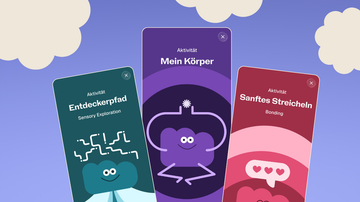
You can find even more scientifically sound information on early childhood development from 0–3 years, over 650 activities, and much more in the mo:mo app.
In der mo:mo App
Aktivitäten zur Selbstregulation für 12–18 Monate.
Wenn dein Kind häufig Wutanfälle bekommt, gibt es in der App 24 abgestimmte Aktivitäten, die helfen, Frustration körperlich zu kanalisieren — ohne dass es eine feste Methode braucht.
Aktivitäten ansehen