


Emotions are present from the very beginning: babies show them even before they have words. They cry, laugh, kick, or turn away. For parents, the question arises: How do I deal with these signals? And what does it actually mean to mirror feelings?
We will discuss this with Christina Grünig, a special needs educator and alternative practitioner for psychotherapy.
What does "mirroring emotions" mean and why is it so important?
Many parents do it intuitively. If a baby cries, they ask: "Does your tummy hurt?" If it smiles, they smile back. Such reactions provide orientation and security even for the youngest children. Small children are still dependent, their nervous system is immature. Mirroring shows them: "Your needs are seen, your feelings are important."
What are the ways to mirror emotions?
For babies, facial expressions and voice play the biggest role. Do I speak soothingly or excitedly, high or low, loud or soft? Do I place my hand comforting? As children get older, they pay more attention to body posture and the meaning of words.
Do I have to name feelings, or is my reaction enough?
Both complement each other. The older children get, the more important language becomes. Only then do they learn: "What I'm feeling right now is hunger." Or: "This is what anger feels like." Parents can start this from birth, and understanding grows over time. They thus take on an important role model function.
What role does mirroring play in attachment?
It is a foundation for secure attachment. Studies show: If feelings are not mirrored, children react restlessly and insecurely. If this happens for a long period, attachment disorders can develop.
What if parents have difficulties with it?
Especially neurodivergent parents may find it difficult to recognize, mirror, or even show emotions themselves. In such cases, I always recommend seeking advice early on from a counseling center and getting help. It is also important not to pretend, but to remain authentic. Uncertainty may also be expressed: "I think you're angry, but I'm not sure. Is that right?" Older children can react well to this. Children of such parents can still experience mirroring from the beginning, for example in kindergarten, with a childminder, or with other relatives. As the saying goes: it takes a village.
Why is it so important for parents to remain authentic?
When parents pretend, children sense it immediately. Example: A mother is exhausted but still says yes to playing Uno. Usually, the mood then sours at the slightest provocation. Parents can say no in such a situation. For many children, this is difficult and feels like a withdrawal of love. However, they can accept it better if their feelings are first acknowledged: "I understand you really want to play. I'm very tired right now. Let's play tomorrow morning."
Which everyday situations are particularly good for mirroring emotions?
Free play, role-playing with dolls or figures, also shared meals or the evening routine: "What made you happy today?" Or: "You're tired, aren't you? Me too." Such moments invite mirroring.
Does mirroring also help with self-regulation?
Yes, it is the prerequisite for it. Small children need co-regulation, especially during emotional storms. Once the emotions have calmed down, parents can name them: "You were angry because your ice cream fell." This way, children learn to categorize their feelings and to regulate themselves over time.
What applies during the autonomy phase?
During this time, the emotional range is enormous. Feelings are big and often overwhelming for small children. Parents should not intervene immediately during emotional storms, but rather give space. They can first observe their child: How does it express itself? What does it feel? How can I best respond to it? It is important that they signal: "I am here, you are safe. All feelings are allowed."
Can parents themselves be role models?
Absolutely. "I'm stressed. That has nothing to do with you. Dad is playing with you now, and I'm going for a short walk." This way, children experience how adults deal with emotions. They learn strategies that they can later apply themselves.
What advice do you give parents who are afraid of making mistakes?
Mirroring usually happens quite naturally. Anyone who feels unsure can – and should – seek advice. It is important to remain self-regulated. Only then will co-regulation also work.
If parents should take away only one thought?
Mirroring emotions is central to the relationship. But staying authentic is just as important. And: parents don't have to understand everything. Sometimes, instead of an "I understand," a "I see you're angry. I'm sorry for you" is enough. Exactly that gives children support and the certainty that they are seen and truly understood.
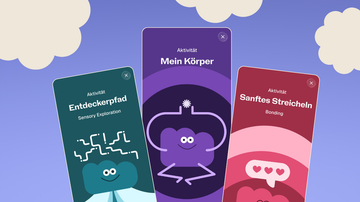
In der mo:mo App
Aktivitäten zur Selbstregulation für 12–18 Monate.
Wenn dein Kind häufig Wutanfälle bekommt, gibt es in der App 24 abgestimmte Aktivitäten, die helfen, Frustration körperlich zu kanalisieren — ohne dass es eine feste Methode braucht.
Aktivitäten ansehen