


Some babies react more quickly to sounds, touches, or changes in their daily routine. They seem more alert, more sensitive to stimuli, or need more time to get used to new things. For parents, this can be unsettling or challenging - especially when compared to other babies.
In conversation with family companion Regina Franz, we clarify what is understood by sensitivity in babies, how it manifests in everyday life, and what ways parents can find to deal with it well.
How do parents notice in everyday life that their baby is particularly sensitive?
As a rule, parents find that their baby seems to tick differently from others. They may be very alert, absorb environmental stimuli like a sponge, find it difficult to fall asleep, or wake up easily. Sensitive babies perceive all sensory stimuli very intensely. For example, they may cry if the parent's shower gel smells too strong for them, categorically reject some foods due to their consistency when weaning, or feel very uncomfortable in certain clothes because the material or a label scratches them too much.
But sensitive babies are not automatically crying babies, are they?
Yes, that's right. Likewise, not every crying baby is a sensitive baby. Crying can have many reasons. Here, a close look is very important. Nevertheless, it can often be observed that sensitive babies cry a lot and may also be difficult to soothe. Sometimes only one parent is well accepted, and the child can only be soothed by that parent.
Parents are probably often asking themselves if their baby's behavior is normal.
Very often, in fact. Parents can sometimes almost despair because their child demands so much of them. But it's important for me to emphasize: Parents are not to blame for their baby being sensitive. They haven't done anything "wrong." These fundamental structures are innate. Family expert Nora Imlau explains innate personality structures as follows: At one end of the scale are babies who are good at self-regulation: they are easy to soothe and fall asleep easily. At the other end of the scale are highly emotional children who are very open to stimuli and highly reactive. Between these points, sensitivity is expressed very differently. Temperament is a spectrum.
Is there a genetic component to this?
There is! Many sensitive babies later turn out to be neurodivergent and are, for example, diagnosed with giftedness, ADHD, or autism spectrum disorder. Multiple diagnoses are also possible. However, whether a child is neurodivergent or not cannot be determined this early. Parents can first document their observations so that they can later be used for a comprehensive and differentiated diagnosis if necessary.
What are typical triggers in everyday life that can make sensitive babies start crying?
Transitions are often a problem: leaving the house, ending a game, going to change a diaper, starting to get dressed, and also falling asleep. Intense stimuli like smells or strong bouncing can also overwhelm the baby. If too much happens to the child at once, it can also be an overload of stimuli.
You mentioned earlier that vigorous bouncing can be counterproductive. But isn't that often recommended to parents? Walking up and down with big strides or bouncing on a exercise ball.
That's true. But the strong up and down motion can be overstimulation for sensitive babies and trigger a protective reaction: the baby falls asleep, but then has to process the stimuli later and may start crying after waking up. A habituation effect is also possible.
What should parents do instead?
They should offer co-regulation: help the child to calm down again with their own calmness. Proximity is important for this. A carrier or a baby wrap can help. Breastfeeding or a bottle can also help the child to settle down. Sometimes, however, the child just wants company.
What does that mean? Shouldn't parents try to stop the crying?
It depends. If a child cries because of hunger, parents should of course react quickly to this need. They can also do something if there is an overload of stimuli. But sometimes everything seems to be fine: the child is fed and clean, there is no commotion around. And yet the baby cries. Then it is often helpful to show the child: I am here - you can let it all out now. Because it's often the same for us: sometimes we just want to vent and don't even want a solution to our problem. Babies cannot articulate this, they can only cry. And so they cry to release stress and pressure. Often, the only thing that helps is to be there and hold them.
That's surely often difficult for parents too.
Definitely. Many parents also wonder if they are doing something wrong. They often hear the saying: relaxed parents, relaxed child. This also suggests: it's because of you that your child is "like this." But often parents simply can't relax properly because the child doesn't allow it.
What can help parents in such situations?
Generally, self-regulation before co-regulation. Babies have fine antennae and are very sensitive to our emotions. If parents enter a situation super stressed, it easily transfers to the child. Parents with sensitive babies need to take very good care of themselves.
And how do they do that?
Essential basic needs should be a priority: sleep, eat, drink. Often, even these are lacking, let alone "me-time." For example, I advise parents to check before bedtime: What needs do I have right now? Do I need to use the restroom? Am I hungry or thirsty? Then I should fulfill these before turning to my child, perhaps for hours. Parents can try to integrate some regulation time and "me-time" wherever possible: with an audiobook in their ears while the child sleeps on them, or with a voice message during a walk. If the child only sleeps with physical contact, a small comfort basket can provide some relaxation, even if it only contains, for example, a cooling eye mask or a hairbrush.
You said earlier that babies' openness to stimuli is often genetic.
That's right. And especially if the parents themselves are very sensitive, the volume of the crying is often difficult for them to bear. Then earplugs that reduce the noise can help. Nevertheless, constant screaming can push parents to their limits.
Can parents get help?
That can work. If the baby strongly prefers one parent over the other, it can already be helpful to reallocate tasks within the family. Then one person puts the baby to bed and the other does the household chores during that time. Family members such as grandparents can also be valuable help. However, not all families have this support.
Does life with sensitive children get easier over time? Or just different?
Sensitive babies retain their fundamental temperament as sensitive children and adults. However, they learn important regulation strategies over time. And parents can teach them these and model them. When exactly everyday life becomes more relaxed is very individual.
Is this sensitivity perhaps also a strength?
Absolutely! These children are very perceptive and experience the world with all their senses. They are creative and often very good at standing up for themselves and their needs, they question things and are very competent. Parental support is very important here. They must strengthen their child's boundaries and show them: You are good just the way you are!
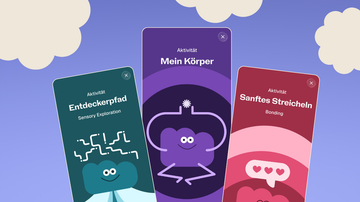
In der mo:mo App
Aktivitäten zur Selbstregulation für 12–18 Monate.
Wenn dein Kind häufig Wutanfälle bekommt, gibt es in der App 24 abgestimmte Aktivitäten, die helfen, Frustration körperlich zu kanalisieren — ohne dass es eine feste Methode braucht.
Aktivitäten ansehen