


What to do when your child is angry, screaming, or simply unwilling to compromise? Many parents wish for a loving and respectful interaction even in these moments – and quickly reach their limits. Nonviolent Communication (NVC) can be a real help here. But what exactly is behind it? And how can NVC be lived out in turbulent family life? We spoke with NVC trainer Tanja Romano – about attitude, language, and why NVC starts with ourselves.
Nonviolent Communication – NVC for short – is unfamiliar to many. Can you briefly explain what it actually is?
Nonviolent Communication, developed by Marshall B. Rosenberg, is a path to more connection and clarity, based on self-responsibility, empathy, and focusing on human needs. NVC is not just a new way of talking to each other. It's more about an attitude: that I am truly aware of myself, that I notice what's going on inside me, and that I truly listen to my child – without judging or condemning. If I practice this, we can much better understand what we really need. And then, interacting becomes more relaxed and loving. It's not rocket science, but a way to interact more consciously – a little more each day.
What exactly does that mean?
Every family with children repeatedly experiences conflict situations. The goal of NVC is to develop an attitude of understanding and connection – both with ourselves and with our child. This involves observing the child's behavior, looking beyond their feelings, and recognizing the underlying needs. In this way, we can stay connected and work together to find solutions that are right for everyone.
That doesn't sound so difficult at first.
It certainly can be. Most parents eventually realize that their children's behavior can trigger old patterns in them. Children's behavior can push our buttons and affect us. It's not always easy to remain calm and composed. That's why NVC starts with self-reflection. We must understand ourselves to break old patterns and respond more respectfully. And that's a big part of my work: to support parents in figuring out what is touched within themselves – and what they need in such moments not to react from old patterns, but to stay connected.
You have 4 children yourself. Do you have an example of this?
Our eldest had a cherry tree from which everyone always snacked. She didn't want that – and one thing led to another, an argument early in the morning. I got really angry. After school, I had cooled down and it was clear to me: I was only so angry because I always had to share everything myself. So why shouldn't my daughter now? I then sat down with her and told her that I regretted how things had gone. That it was my anger, and it would stay with me. We were able to talk very calmly and it turned out that she was indeed willing to share. We just needed to ask her before taking anything. So simple.
NVC doesn't mean the child always gets their way in the end, right?
No, that's not what it means at all. NVC has nothing to do with laissez-faire parenting. On the contrary, children need a lot of guidance, orientation, and structure. Parents are allowed and should absolutely set boundaries. Children need this guidance. For example: Let's imagine a two-year-old toddler only wants to eat plain pasta. Morning, noon, and night. I've cooked lunch – but not pasta, something with vegetables.
The child will probably get angry then.
Exactly. I first stay connected and describe what I see – without judgment: "You really wanted pasta now, and now you're really angry – and Mommy cooked vegetables. You think that's totally stupid right now."
Then I look behind it to see what the child really wants: "You want to decide what you eat – that's important to you."
And yet, as a mom, I can also show my responsibility and be clear: "At the same time, I want to take good care of you – and for me, that includes you getting vegetables."
This way, I set a clear boundary – there are no (or perhaps not only) noodles – and still stay connected with my child. I see you. And I take you seriously. And most importantly: I stay connected with myself, even when my child's outburst of anger follows.
I noticed you didn't say "but" but "at the same time I want to take good care of you."
In Nonviolent Communication, it's not about strictly prohibiting individual words, but about how language promotes or blocks connection. The word "but" often acts as a contradiction that relativizes or weakens what was said before. We all know it: "Your glasses are nice, but..." – and suddenly the compliment no longer sounds genuine. That's why it's worth replacing "but" with, for example, "and" or "at the same time." This way, we remain open in conversation, promote understanding, and maintain connection.
Are there any other words you avoid?
Yes, typical words like "not" or generalizations like "one" or "always" can also disrupt connection. They limit the quality of the conversation because they often convey blame or generalizations. Instead of "You don't do that!" it is much more helpful to remain concrete and personal: "I find that difficult right now." In Nonviolent Communication, we rely on clear, personal, and concrete statements that are honest and allow for solutions. However, I want to emphasize again that it's much more about the attitude behind the words than the words themselves.
Isn't that a big adjustment?
Yes – at first, it is. We grew up in a world where guilt, judgment, and control are everyday occurrences. It takes time until we rediscover the language of life – the language of needs. However, every time we pause and ask: What am I feeling right now? What do I really need? – change begins.
Does NVC work with young children?
Yes, absolutely! NVC is not a question of age – but of attitude. Even small children respond to connection, to true listening, and to clear, lovingly set boundaries. And of course, they don't yet understand "needs analysis" – but they immediately sense whether we take them seriously or impose something on them. It is important that NVC is not misused as a language model.
And the beautiful thing is: You can start anytime. I also support parents with teenagers, where suddenly whole new doors open – because interaction is no longer characterized by power struggles, but by mutual understanding.
I imagine it's difficult to react so calmly in the midst of conflict situations. Observing, recognizing needs, reacting appropriately, paying attention to language – that can certainly be overwhelming at first, can't it?
Yes, absolutely – many people feel that way. Especially at the beginning, it can feel like juggling on a unicycle: observing, feeling, formulating – and all this while your child might be screaming or throwing themselves on the floor. And that's totally okay. Children don't need a perfection program, but an invitation to develop and experiment. Sometimes it doesn't work out in the moment – and even after the conflict, we can look at it: What was actually going on? What did I need – and what did my child need? What would I like to do differently next time?
This kind of self-reflection is a very important part of NVC. I like to compare it to my cherry tree example: I could only say afterward that I regretted how I reacted – and at the same time, that was a valuable learning experience.
What do parents discover in your counseling?
I start by simply listening to what moves them and what we can work with. I explain to parents what NVC actually is: What is it about? What attitude and view of humanity do we live with NVC? And so everyone can first see: Is this even for me? In empathetic coaching, we take small steps and try to understand situations. It's first about parents understanding themselves. And only in the second step is it about the child.
What changes, based on your experience, in the families you support through NVC?
Nonviolent Communication does not primarily change behavior – but the inner attitude with which we view situations. Parents who work with NVC often experience: The external conflict is not the real problem – but what happens within me when my child says "no," screams, or tests boundaries. As soon as I learn to understand my own reactions, a space is created. I get choices. I don't have to "react" immediately. I can first stay with myself. What changes? Not the children – but the way parents deal with themselves and look at the situation.
And from that, much follows almost automatically: less stress, less escalation, less friction. NVC is not a method of child-rearing. It is an attitude with which we shape relationships – clear, binding, and mature.
You can find even more scientifically-backed information on early childhood development from 0–3 years, over 650 activities, and much more in the mo:mo app.
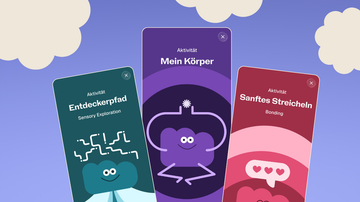
In der mo:mo App
Aktivitäten zur Selbstregulation für 12–18 Monate.
Wenn dein Kind häufig Wutanfälle bekommt, gibt es in der App 24 abgestimmte Aktivitäten, die helfen, Frustration körperlich zu kanalisieren — ohne dass es eine feste Methode braucht.
Aktivitäten ansehen