


Reading time: 4 min
In the first 3 years of life, a child's brain develops faster than at any other time. Every experience, every touch, every word leaves its mark – literally.
While adults form about 1,000 neural connections per second, babies form up to 1 million per second. This immense activity shows how intensely the brain learns and structures itself during this period.
A Network of Experiences
A newborn's brain consists of around 100 billion nerve cells. Initially, these are barely connected. It is only through experiences that connections – called synapses – are formed.
When a baby smiles and a caregiver smiles back, a connection is strengthened. When it hears music, recognizes a familiar voice, or grasps something new, new pathways are formed.
This creates a huge network that forms the basis for all later abilities: perception, language, movement, empathy, and self-regulation.
The mo:mo app helps parents consciously shape such experiences – with ideas that perfectly match this intensive developmental phase.
Learning through Relationship
The brain does not learn in isolation, but in relationship. Closeness, attention, and loving interaction provide security – and create the foundation for children to learn at all.
Oxytocin, the so-called bonding hormone, plays a central role in this. It reduces stress, strengthens trust, and ensures that the brain attunes to social signals.
Children who feel safe and secure can explore their environment with curiosity. This promotes neural activity and ensures that connections are strengthened.
Therefore, attachment is not a trivial matter, but the basis of all cognitive and emotional development. You can find more about this in the mo:mo expert blog.
Pruning: Why the Brain Also Lets Go
The infant brain grows rapidly – but not everything remains. After the phase of intensive networking, so-called pruning (synaptic reduction) begins.
In this process, rarely used connections are eliminated, while frequently used ones remain stable. The brain thus filters out what it needs and refines itself.
This process is crucial for efficiency. Everything a child regularly experiences – language, touch, movement, affection – is "stored" in the brain. Anything that is not meaningful disappears again.
You can imagine it like a garden: In the first few years, everything grows wild and dense. Afterwards, it is carefully thinned out so that what is important gets space.
Movement, Language, and Sensory Experiences
Every experience affects the brain. Movement not only strengthens muscles but also neural connections. Language, music, and rhythm promote networks between auditory and language centers.
When children explore the world with all their senses – smelling, touching, hearing, tasting, seeing – it activates various brain regions simultaneously. The brain learns to link and process stimuli.
Even small routines, such as cuddles with the konnektor or simple ball games with the bouncing buddy, support this development because they combine tactile, social, and motor stimuli.
Why Early Experiences Are So Formative
Experiences in the first 3 years shape how the brain processes information and how children later deal with stress, emotions, and social situations.
Positive experiences foster trust, motivation, and joy of learning. Chronic stress, however, can disrupt the balance of the nervous system and long-term impair emotional regulation.
That's why it's so important for children to experience security, closeness, and stimulation during this time. They don't need many stimuli, but the right ones: familiar voices, gentle touch, time to play and discover.
Tips for Parents
- Talk to your child, even if they don't answer yet. Language connects brain regions.
- Touch them frequently and lovingly. Physical contact strengthens bonding and neural development.
- Give your child time to discover things themselves. Independent action promotes self-efficacy.
- Repetitions are important: They strengthen connections in the brain.
- Provide periods of rest. Only a well-rested brain can process new impressions.
- Use inspirations from the mo:mo app to consciously guide development in everyday life.
- Conclusion
In the first 3 years of life, the foundation is laid for everything a person will later be able to do, feel, and understand. The brain grows, connects, and forms itself, driven by experiences, affection, and curiosity.
Every loving interaction, every game, every conversation strengthens this development. Parents don't need to use special programs for this – but they do need to be consciously present.
The mo:mo app supports you with practical ideas that show: Development begins in the small things – in moments that connect, strengthen, and endure.
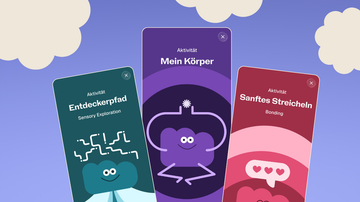
In der mo:mo App
Aktivitäten zur Selbstregulation für 12–18 Monate.
Wenn dein Kind häufig Wutanfälle bekommt, gibt es in der App 24 abgestimmte Aktivitäten, die helfen, Frustration körperlich zu kanalisieren — ohne dass es eine feste Methode braucht.
Aktivitäten ansehen