


Reading time: 3 min
At the playground, in the playgroup, or during family visits: Sooner or later, a sentence is uttered that triggers something in parents. "Mine is already walking." "Ours has been sleeping through the night for ages." "Our child is already really good at talking."
Almost every mother, almost every father knows this moment and this brief comparison: How far along is my child? Are we doing something differently?
Comparisons happen automatically. They are part of being a parent. But they can also make us insecure if we get too caught up in them.
Why comparisons are so obvious
People seek orientation. We want to know if something is "normal," if we are on the right track. Especially during parental leave, when so much is new, looking at others helps.
When others say their child is already crawling or talking, it sounds like security. Like a kind of benchmark to hold onto. But children are not measuring sticks. They develop at their own pace, depending on maturity, temperament, and experience.
Comparisons offer brief orientation, but they often obscure what really matters: development at one's own pace.
Development does not follow a fixed plan
Children do not grow according to tables. They walk, talk, and think at very different speeds. One moves early and speaks late, the other climbs hesitantly but quickly forms first sentences.
Such differences are no cause for concern, but rather an expression of individuality. Development is an interplay of many factors: physical maturity, inner motivation, attachment experiences, sleep, nutrition, daily form.
Those who try to measure children against each other easily overlook the subtle progress that is not captured in photos – like the first time a child points at something, listens attentively, or shares a thought.
When comparisons create pressure
The problem is not the comparison itself, but the meaning we give it.
Many parents feel stress when others seem to be "further along." The feeling of falling behind can be exhausting – especially when social media entices with perfectly running routines and happy babies.
But these images show snippets, not reality. Children who walk early do not automatically have fewer challenges. And those who speak a little later usually catch up faster than one might think.
Development happens in phases. Sometimes it progresses visibly, then everything seems to stand still again, while new things mature internally.
Trust helps more than control
Children need adults who give them time. A child who feels allowed to develop learns with joy. A child who constantly meets expectations learns with pressure.
When parents show serenity, trust arises, and with it the space in which development happens naturally.
Sometimes it helps to change perspective: Not to ask when a child can do something, but how they are experiencing the world right now.
Perhaps they prefer to observe rather than act. Perhaps they listen before they speak. Both are development – just in a different way.
What strengthens parents
Comparisons cannot be entirely avoided. But they can be put into perspective. It is helpful to consciously perceive what they trigger in oneself: Pressure? Insecurity? Perhaps even relief?
Those who understand why comparisons arise can more easily detach themselves from them. Then the constant "When can your child do that?" becomes a curious "How do they actually do that?"
And that's exactly where what children truly need begins: genuine attention, not competition.
You can find more shared moments and activities in the mo:mo App.
Conclusion
Comparisons are human. They show that parents care. But no child develops according to a schema. When parents stop seeing others as a benchmark, they discover what makes their child unique.
Frequently Asked Questions from Parents
Why do I compare myself to other parents at all?
Because it provides security. Exchanging with others shows that no one has everything under control. But as soon as comparisons create pressure, it's worth looking inward: What is truly making me insecure?
How can I become more relaxed when other children seem to be "further along"?
By realizing that every child has their own strengths. Observing today, trying tomorrow: development happens in waves. Don't stick to apps with fixed developmental points, but rather orient yourself to pediatric milestones, such as those used by the mo:mo App.
When should I have my child observed more closely?
If you notice over a longer period that your child shows little interest in movement, language, or contact, a conversation with specialists can help. Often, a brief assessment is enough to regain confidence.
Does it help to know developmental charts?
As an orientation – yes. But they don't replace observation. The true measure of development is your everyday life: how your child plays, reacts, expresses themselves.
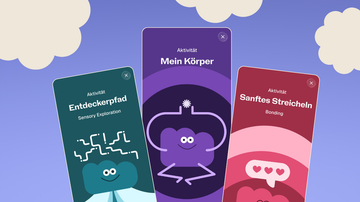
In der mo:mo App
Aktivitäten zur Selbstregulation für 12–18 Monate.
Wenn dein Kind häufig Wutanfälle bekommt, gibt es in der App 24 abgestimmte Aktivitäten, die helfen, Frustration körperlich zu kanalisieren — ohne dass es eine feste Methode braucht.
Aktivitäten ansehen