


Reading time: 4 min
Children love repetition. It provides orientation and a sense of security. Rituals are like anchor points in everyday life – small moments that show: Everything is good, I am safe. Whether waking up, eating, or before falling asleep in the evening: familiar routines create calm and reliability.
Rituals are not strict rules. They emerge through repetition, through consistent gestures and words that structure the day and organize children internally. When daily life runs reliably, children can process new things much better.
Why rituals are so important
Children's daily lives are full of impressions. Sounds, faces, new places – everything is still unfamiliar. Rituals help to sort this abundance. They make the day predictable and provide support.
The brain loves patterns. When routines are similar, stable connections are formed between nerve cells. Children feel more secure and can direct their energy towards discovery rather than orientation.
A consistent good morning song or a familiar phrase at bedtime is often enough for children to know: Now comes the next step. Such small constants provide security, especially when there is a lot of movement externally.
Rituals connect
Rituals are more than structure. They are an expression of relationship. When parents consciously pause during diaper changes, teeth brushing, or cuddling, closeness is created.
Physical contact plays a central role. A gentle touch or a stroke with the Konnektor can help create moments of calm and attention. This builds familiarity – through touch, voice, and repetition.
In the mo:mo app, you will find suggestions for small rituals that can be easily integrated into your day. They support bonding and help make transitions gentle.
Language also plays an important role. Recurring words, rhymes, or lullabies give children orientation. When parents use similar phrases ("Now we'll bundle you up warm" or "Sleep well, see you tomorrow"), these words become signals for security.
Structure creates security
Children cannot yet measure time. They experience it through routines. A clear daily rhythm helps them orient themselves: waking up, breakfast, playing, lunch, rest, sleep.
Such structures don't have to be rigid. It's not about control, but about reliability. Small rituals within this structure – such as tidying up together after playing or dimming the lights before bedtime – create orientation.
Children sense when the rhythm of the day repeats. They recognize transitions – from playing to eating, from hustle and bustle to calm. This gives them security because they understand what will happen next.
Rituals are also helpful for parents. They momentarily slow down everyday life and create islands of calm. A shared goodnight song or a brief conversation in the evening can help conclude the day – for children and adults alike.
Development through repetition
Rituals not only foster emotional security but also cognitive development. Children who know what will happen next can understand, anticipate, and help shape processes.
An evening bedtime ritual with recurring steps (lights out, singing, stroking) signals to the body: It's time to calm down. The organism adjusts to relaxation. You can read why lullabies are particularly helpful in our blog.
This is how children learn to find their inner rhythm. This self-regulation is one of the most important foundations for emotional stability.
Rituals also support language, memory, and concentration. Repeated routines and familiar phrases become deeply ingrained in the brain. When children join in the routine or take on a task themselves, such as turning off the light or getting their toothbrush, they experience self-efficacy.
Rituals change with age
As children grow older, rituals evolve. What provides closeness and security in infancy becomes a moment of independence in toddlerhood.
A baby enjoys the same bedtime routine – the familiar voice, the gentle touch. A two-year-old might want to get their blanket or choose the song themselves.
In this way, children grow into their rituals and gradually shape them. Parents can accompany this process by perceiving new needs and gently adjusting the routine.
Family rituals also change when siblings arrive or life circumstances change. What's important is that a basic pattern remains: reliability, repetition, affection.
Living rituals in everyday life
Rituals don't have to be grand. Often, it's the small, inconspicuous moments that make the difference. A kiss goodbye, waving at the window, the song while brushing teeth, or the brief "How was your day?" – they all create connection.
Some families create fixed weekly rituals: shared Sunday breakfast, walks, or small family evenings. Others use rituals to initiate calm phases – a story, a massage with the Konnektor, a shared breathing exercise.
In the mo:mo app, you'll find many such impulses that help create a harmonious day and refocus on what truly matters: connection instead of perfection.
Tips for parents
- Choose rituals that suit you. It's not about perfection, but about reliability.
- Stay flexible. Rituals can change as children grow.
- Less is often more. Better one conscious ritual than many half-hearted ones.
- Use rituals to create closeness – through touch, voice, or eye contact.
- Let your child participate. When they are involved, they experience self-efficacy.
- Small everyday helpers like the Konnektor can accompany such moments – when arriving, calming down, or falling asleep.
Conclusion
Rituals are like silent signposts throughout the day. They provide structure, create security, and make closeness tangible. In repetition lies reliability, and in reliability, bonding is created.
Those who consciously shape rituals strengthen their child's trust in themselves and in the world. Often, it's the small actions that remain: a song, a touch, a glance.
The mo:mo app offers many ideas on how such routines can easily become part of your everyday life – gently, familiarly, and without any pressure.
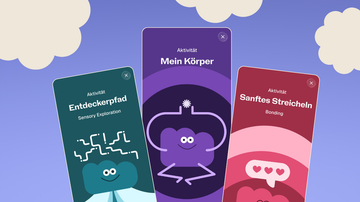
In der mo:mo App
Aktivitäten zur Selbstregulation für 12–18 Monate.
Wenn dein Kind häufig Wutanfälle bekommt, gibt es in der App 24 abgestimmte Aktivitäten, die helfen, Frustration körperlich zu kanalisieren — ohne dass es eine feste Methode braucht.
Aktivitäten ansehen