


Too many tips, too little clarity? If you're wondering when your baby should roll, grasp, or speak their first words, you're not alone. Everywhere you look, there are tables and comparisons that create more pressure than reassurance. But there's a scientifically sound way to bring calm to this topic: the milestone principle. It's the basis on which pediatricians and developmental experts – and also us at mo:mo – understand and support your child's progress.
This article is your reliable guide. We translate the science behind milestones into clear knowledge so you can support your child's development with confidence and serenity – without the pressure of rigid timelines.
What exactly is the milestone principle?
Perhaps you've heard the term in a pediatrician's office. It sounds complex, but at its core, it's quite simple: the milestone principle is a scientific method for classifying child development. It's not a rigid checklist, but rather a map with broad paths.
The core of the principle: Over decades, researchers have observed thousands of children to determine the timeframes in which specific skills are typically learned. These timeframes are called "developmental windows."
- Fact: The principle defines a normal range, usually from the 3rd to the 95th percentile. This means that out of 100 healthy children, 94 will develop a skill within this very broad timeframe. Only a small group will be earlier or later, which is not immediately a cause for concern.
A "milestone" marks the point at which approximately 90–95% of children have already acquired a certain skill. It is therefore not a target date, but a gentle indicator for professionals to look more closely if needed. It serves for early detection and support, not for comparison.
A look at history: Where do milestones come from?
The idea of observing developmental steps is not new. It is based on almost a century of scientific work that has become increasingly refined and global.
- The beginnings (1920s): American psychologist Dr. Arnold Gesell pioneered this work. He systematically observed hundreds of children and was one of the first to recognize that development follows predictable patterns. His work laid the foundation for our current understanding.
- Standardization (1960s): Building on this, screening tools such as the Denver Developmental Screening Test were developed. It helped for the first time to establish a standardized method for better assessing child development in practices worldwide.
- The global gold standard (Today): The most comprehensive and important foundation today is the WHO Multicentre Growth Reference Study (MGRS), published in 2006. For this study, over 8,000 children from various countries (Brazil, Ghana, India, Norway, Oman, and the USA) were followed under optimal conditions. It provides us with the most reliable data today on how diverse and yet structured human development proceeds.
This long research tradition shows: the milestone principle is not a passing fad, but a proven scientific tool.
How a milestone is created: The science of data
You might be wondering how a concrete milestone is derived from all these observations. The process is purely statistical and relies on large amounts of data.
Imagine 100 babies who are just learning to roll from their back to their tummy.
- Observation: Researchers document at what age each of these 100 babies first shows the ability.
- Data collection: They notice that some manage it as early as 3 months, most between 4 and 6 months, and a few only at 7 months.
- Definition of the window: The developmental window for rolling could therefore range from 3 to 7 months. This is the "normal" range.
- Setting the milestone: The milestone is placed at the end of this window. It is the point at which almost all children (e.g., 97 out of 100) have mastered this step. Reaching a milestone therefore does not mean "delayed," but merely that a child belongs to the smaller part of the group that needs a little more time for this step.
This knowledge is incredibly reassuring. It frees you from the idea that your child must master a skill on a certain day X. Instead, it gives you the certainty that there is a wide spectrum of "just right."
If you have a specific question about a milestone, you can ask our experts directly – simply contact us at customer@momo.kids or download the mo:mo app.
Focus on individuality: Why every child takes their own path
Perhaps the most important message of the milestone principle is this: development is individual. The broad developmental windows exist because every child is unique.
Several factors play a role here:
- Genetics: Biological predisposition provides a rough roadmap.
- Environment: Stimulation, interaction, and opportunities to practice shape the path.
- Temperament: A cautious child will approach motor challenges differently than an adventurous one.
It is completely normal for a child to perhaps first focus their energy on gross motor skills and reach milestones like crawling and scooting early, while still waiting to speak. Another child might babble early but take more time to learn to walk. This is not a race, but an expression of personality.
The mo:mo app helps you to see and celebrate your child's unique path, instead of comparing it with rigid tables.
Frequent questions about the milestone principle
Here we answer some of the most pressing questions parents have on this topic.
My child "missed" a milestone. Do I need to worry?
No, not immediately. A missed milestone is primarily a signal for your pediatrician to look more closely at development. It is a tool for early detection, not a diagnosis. Often a child just needs a small impulse or targeted stimulation. Discuss it at the next check-up – that's what these appointments are for. The mo:mo app will inform you if a milestone has been "missed."
Isn't all this just performance pressure for parents and children?
It can be, if misunderstood. That's why proper classification is so important. At mo:mo, we don't use the milestone principle to create pressure, but to give you the right playful suggestions at the right time. It's about support and shared discovery, not performance.
Does the milestone principle also take cultural differences into account?
An important and legitimate question. Older studies were often focused on Western cultures. That's exactly why the WHO MGRS study is so valuable, as it included children from six very different countries. It offers a significantly more global perspective. Nevertheless, we know that parenting practices can influence development. Our over 45 mo:mo experts help us to translate this scientific data into the context of our daily lives.
Can I accelerate my child's development?
Development cannot be accelerated, but it can be wonderfully supported. A child learns to grasp when their nervous system and muscles are ready for it. What you can do is provide them with the right environment and appropriate stimuli – a rattle at the right time, enough tummy time to practice. It's about opening doors, not pushing someone through them.
---
🌱 Why the milestone principle works
-
Large data basis: It is based on the observation of thousands of children worldwide, which makes it statistically very reliable (e.g., WHO MGRS Study).
- Focus on time windows: It defines broad timeframes for development, which accounts for the natural variation between children.
- Proven screening tool: It has helped professionals for decades to identify potential support needs early, without premature judgment.
---
The milestone principle is essentially an invitation to look closely and celebrate your child's unique progress. With knowledge of the background, you can now view developmental tables with more serenity.
If you have a specific question about your child's development, you can quickly find a well-founded answer from our team of experts in the Ask mo:mo function. And the next suitable play idea, precisely tailored to your child's current developmental window, is already waiting for you in the app.
P.S. The best way to playfully and scientifically support your child's development from the very beginning is our Starter Set. It combines full app access with a practical tool for your shared moments.
You now have the knowledge to support your child's development with calm and confidence. The next small step? Simply enjoy the moment and marvel at all your child can already do.
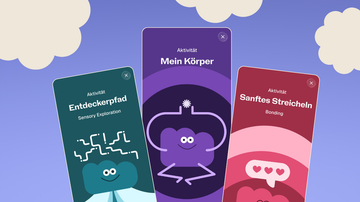
In der mo:mo App
Aktivitäten zur Selbstregulation für 12–18 Monate.
Wenn dein Kind häufig Wutanfälle bekommt, gibt es in der App 24 abgestimmte Aktivitäten, die helfen, Frustration körperlich zu kanalisieren — ohne dass es eine feste Methode braucht.
Aktivitäten ansehen