


The Neurobiological Benefits of Creative Play: How Painting, Building, and Pretending Shape Your Child's Brain
Sometimes you might sit next to your child, watching them stack blocks into a wobbly tower that immediately collapses, or observe them drawing colorful scribbles on a piece of paper with full devotion. In these moments, you might wonder: "Does this really accomplish anything, besides a lot of fun and a bit of chaos?" The neurobiological answer is a clear and fascinating yes. Each of these creative moments is a crucial workout for your child's developing brain, laying the foundation for their entire early childhood development.
A Look Inside the Brain: What Really Happens During Creative Play
It often feels like magic, but behind your child's play lies solid science. The brain of a baby or toddler is not a finished hard drive, but a dynamic construction site. At birth, it already has almost all the nerve cells it will ever have – but the crucial part is still missing: the connections.
Feeling: You watch your child try something for the first time.
Fact: At precisely that moment, neurons in their brain fire and form new connections, called synapses. Creative, free play is the turbocharger for this process. It creates countless opportunities for new experiences that literally shape the brain. This is known as neuroplasticity – the brain's ability to change and learn through experience. If your child repeats an action, this connection becomes stronger and faster, like a small initial road that is expanded into a data highway.
Various brain areas are active in teamwork:
- The prefrontal cortex (the little CEO): This area behind the forehead is responsible for planning, problem-solving, and concentration. When your child considers which block fits next on the tower, they are training precisely this important part of their brain.
- The limbic system (the emotion center): Creative play is often associated with strong, positive emotions. The joy of a finished tower or a painted picture leads to the release of happiness hormones like dopamine (the "again!" neurotransmitter) and serotonin (the feel-good neurotransmitter). This not only motivates but also embeds what is learned more deeply.
From Feeling to Fantasizing: Creative Play in Action
Creative play is diverse, and each form has its own superpowers for the brain. Let's take a closer look at three core areas.
Painting & Scribbling: More Than Just Colorful Lines
Feeling: Your child's scribbles might not look like a work of art yet.
Fact: Every stroke is a complex process for the brain. The movement of the pen trains fine motor skills and strengthens the nerve pathways between the brain and hand (the motor cortex). At the same time, it promotes hand-eye coordination, an essential skill for later writing and many other daily tasks.
Action: Simply lay a large sheet of paper on the floor and give your child thick, easy-to-grip crayons. It's not about the result, but about the process of experimenting.
Building & Constructing: Making the World Tangible
Feeling: The tower collapses again, and your child is frustrated.
Fact: Exactly that is the learning moment! When building, your child discovers physical laws like gravity and balance. They train their spatial reasoning and problem-solving skills. Every attempt to make the tower more stable is a small experiment that promotes logical thinking.
Action: Start with soft, large building blocks. Name what happens: "Oh, the block fell down. Let's try a bigger one at the bottom."
Fantasy & Role-Playing: Learning to Understand Emotions
Feeling: Your child is talking to their stuffed animal.
Fact: This is social brain training at the highest level. In "make-believe" play, your child slips into other roles, practices empathy, and learns to change perspectives. They experiment with language, social rules, and process experiences. The prefrontal cortex is working at full throttle to manage these complex social scenarios.
Action: Play along! Give the teddy a voice and ask your child how the teddy might feel. This playfully supports emotional intelligence.
Age-Appropriate Play Impulses: What Your Child Needs Right Now
The brain develops in phases. What fascinates a baby might already bore a toddler. Here are some suggestions tailored to the respective developmental stage.
- For babies (approx. 0-12 months): The brain now primarily learns through the senses. Offer various materials to feel (soft, rough, cool), play peek-a-boo (trains object permanence), or sing simple songs with movements. Every sensory experience builds fundamental neural connections.
- For young toddlers (approx. 1-2 years): Cause and effect are exciting now. Simple stacking towers, emptying and filling boxes, or painting with water on the patio are perfect. The brain learns: "If I do this, that happens."
- For older toddlers (approx. 2-3 years): Imagination awakens. Simple dress-up, a box that becomes a car, or re-enacting everyday situations (cooking, shopping) greatly promote language, social skills, and creativity now.
A Common Myth: "Creativity Is Innate, Right?"
Feeling: You're worried because you yourself aren't "creative" and might not be able to pass it on to your child.
Fact: Research clearly shows: Creativity is not an innate talent that you either have or don't have. It is more of a skill that is trained like a muscle. Every child is born with a huge amount of curiosity and a spirit of discovery. By giving them space for free, unstructured play, we strengthen this "creativity muscle." Contrary to the old notion of the "left" (logical) and "right" (creative) brain hemispheres, we now know that in creative processes, complex neural networks work together across the entire brain.
Action: Trust that your child is the expert on their own play. Observe first, instead of intervening immediately. Unscheduled time is not wasted time, but valuable brain-building time.
---
A Moment for the Family
Capture these small and large discoveries. A photo of the first self-built tower or the most colorful finger painting is a wonderful memory. In your "Family Account" at mo:mo, you can securely share these moments only with loved ones – completely privately and without the pressure of social networks.
---
Why it Works: The Neuro-Facts at a Glance
- Neural Networking: Every new play experience creates and strengthens connections (synapses) in the brain. This is the basis of all learning. [verify source]
- Dopamine Release: The pure joy of creating and discovering releases dopamine, which motivates your child to remain curious and seek challenges.
- Holistic Activation: Creative play simultaneously engages cognitive, motor, and emotional brain areas, promoting balanced development.
- Flexible Thinking: The brain learns to view problems from different perspectives and find new, unique solutions – a key competence for life.
---
Are you unsure which creative activity is best suited for your child's development right now? Ask "Ask mo:mo", our 24/7 chat in the app. There you will also find over 650 playful activities tailored precisely to your child's age.
PS: Want to start right away? The "Starter Set" is the perfect combination of digital inspiration and haptic experience. It includes full app access and high-quality, development-promoting toys for shared discoveries from the very beginning.
Forget the pressure to provide a perfect play program. The most chaotic art table can be the most valuable brain-building site. The next small step? Just offer a pen and paper again today and curiously watch what happens.
Frequently Asked Questions (FAQ)
What are the neurobiological benefits of creative play?
Creative play promotes neuroplasticity, which is the brain's ability to shape itself through experience. It strengthens neural connections (synapses), activates important brain areas like the prefrontal cortex for problem-solving, and releases neurotransmitters like dopamine, which boosts learning motivation.
How does creative play specifically shape the brain?
Every playful action – a stroke with a pen, stacking a block – causes neurons to fire and form new connections. Repetition strengthens these connections, creating efficient neural networks for motor, cognitive, social, and emotional skills.
Which play is best for babies' brains?
For babies, sensory play is crucial. Activities that engage various senses – touch, sight, hearing – are ideal. Simple games like peek-a-boo, grasping different objects, or listening to songs build the fundamental neural foundations for all further learning.
***
Disclaimer: This article is for general information purposes only and does not replace professional medical or educational advice. If you have concerns about your child's development, please consult a pediatrician or a relevant specialist.
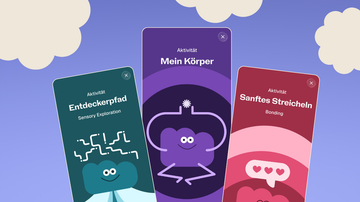
In der mo:mo App
Aktivitäten zur Selbstregulation für 12–18 Monate.
Wenn dein Kind häufig Wutanfälle bekommt, gibt es in der App 24 abgestimmte Aktivitäten, die helfen, Frustration körperlich zu kanalisieren — ohne dass es eine feste Methode braucht.
Aktivitäten ansehen