

Reading time: 5 min
For children, the playground is much more than just a place to let off steam. It's a space where movement, courage, curiosity, and social interaction come together. For parents, it might sometimes seem chaotic, but the seemingly wild climbing, sliding, and balancing hold enormous learning opportunities.
Playing is a child's work. And the playground is their biggest laboratory: here they learn what their body can do, what balance feels like, when courage is good – and when caution is important.
Movement as the basis of development
Children need movement to develop. Every new physical ability arises through trial and error: running, jumping, climbing, throwing – all of this shapes muscles, balance, and coordination.
The playground offers ideal conditions for this. Different surfaces, heights, speeds, and materials stimulate the senses and train the interplay between the brain and body.
When children climb, they strengthen their deep muscles, train their balance, and practice estimating distances. When sliding, they experience speed, when swinging, they learn rhythm and balance. Even running over uneven ground trains the ability to coordinate movements.
This variety is crucial. It promotes gross motor skills, strength, endurance, and simultaneously conveys a sense of security and trust in one's own body.
Parents who use the mo:mo app can specifically support such developmental steps: there you will find ideas on how to playfully incorporate everyday movements and support motor development.
Risky Play: Why taking chances is important
Parents often find it difficult to watch children climb high or hang from a rope. But precisely these moments are valuable. Risky Play describes the child-appropriate exploration of risks – balancing on a boundary between safety and challenge.
Children who are allowed to try things out learn: How high can I climb? How far can I jump? What happens if I fall – and get back up?
These experiences are indispensable for developing self-confidence and risk competence. Those who try small challenges as a child can better assess dangers later on.
Of course, this requires attentive adults, but not constant intervention. Children learn best when they retain control over their actions and are allowed to experience mistakes.
Playground as a place of social development
On the playground, children meet other children. They observe, imitate, negotiate, argue, and reconcile. These experiences are social learning environments that no adult can replace in this form.
A child who observes others sliding or swinging not only learns about movement. They learn about cooperation, patience, and perspective-taking. Those who take turns on the swing or help build a sandcastle develop empathy and communication skills.
Sometimes conflicts arise, and that is important. Playground situations are initial training grounds for self-assertion, compromise, and consideration.
Playing outdoors: Nature as a space for development
Playing outdoors means experiencing with all senses. Wind, sun, sand, grass, water: they all stimulate perception and body awareness. Children who play outdoors regularly are more balanced, more motorically secure, and more creative in dealing with challenges.
Outdoor movement also plays a major role in concentration. Studies show that children who regularly exercise outdoors are more attentive and stress-resistant.
Motor skill development with simple means
Playgrounds are ideal, but there are also opportunities in everyday life to promote movement and motor skills. Small games with a ball, like the bouncing buddy, stimulate hand-eye coordination, force regulation, and reaction time. Even simple catching games or rolling a ball train many senses simultaneously and make it visible how learning occurs through movement.
Here, too, the perfect technique is not what counts, but trying things out. Mistakes are part of it; they make children more confident.
Courage, Trust, and Self-Efficacy
A child who climbs and jumps experiences self-efficacy. They realize: I can achieve something that seemed impossible before. This experience strengthens courage and self-confidence and shapes their attitude towards new challenges in the long term.
Parents can support this process by encouraging instead of hindering. A simple "I see how you're concentrating" is more effective than a "Watch out!". Children need trust to dare.
The mo:mo app offers inspiration on how to consciously accompany such moments: with small impulses that promote bonding and development in everyday life.
Safety and Boundaries
Safety, of course, remains important. Playgrounds are designed so that children can try things out without being seriously endangered. Nevertheless, it makes sense to remain attentive without overprotecting.
Small falls or scrapes are part of learning. They teach that risk is manageable and that failure does not mean defeat. Only in this way do children develop a realistic sense of danger and their own abilities.
Tips for Parents
- Give your child the freedom to decide for themselves how to play. Trust strengthens self-confidence.
- Encourage rather than warn. A calm look says more than a "Watch out!".
- Allow small risks – they teach children to assess their limits.
- Take time to observe. You will see how much learning is in free play.
- Play together without directing. Let yourself be led, not vice versa.
- Supplement everyday life with movement: A ball like the bouncing buddy promotes coordination and reaction time even at home.
Conclusion
The playground is more than just a place to play: it is a space for experience. Here, children grow beyond themselves, develop self-confidence, learn their limits, and experience that courage is rewarded.
Every slide, every climb, every small risk promotes motor, emotional, and social development. Movement strengthens the body, risky play strengthens trust in one's own abilities.
Parents also benefit when they pause and observe how their child learns to assess risks and take responsibility for themselves. Consciously accompanying such moments lays the foundation for independence and security.
In the mo:mo app you will find many ideas on how to support these developmental steps in everyday life – with small impulses that encourage, create connection, and show: playing is learning in motion.
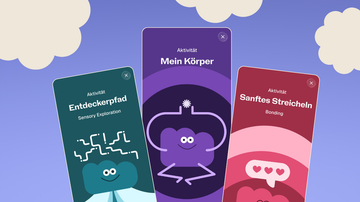
In der mo:mo App
Aktivitäten zur Selbstregulation für 12–18 Monate.
Wenn dein Kind häufig Wutanfälle bekommt, gibt es in der App 24 abgestimmte Aktivitäten, die helfen, Frustration körperlich zu kanalisieren — ohne dass es eine feste Methode braucht.
Aktivitäten ansehen