


Even in their early years, children want to accomplish many things on their own. They reach for a spoon, try to put on their shoes, or take things off a shelf. For parents, the question often arises: How much support is appropriate, and where should you simply give the child space?
Nursery educator Laura Braatz discusses this topic. She explains how early independence develops, why it's so important, and what impulses families can incorporate into their daily lives.
What does "independence" even mean at nursery age?
Independence is evident even in the youngest children: they want to actively participate in daily life and achieve things on their own. This doesn't have to be perfect or fast, and it's okay if things don't go as planned. It's important that children are given the chance to do things themselves. This is where the foundation is laid.
Which everyday situations are particularly suitable for this?
Almost all of them, actually. Children can participate in brushing their teeth (parents brush afterwards), choose clothes for the next day from a small selection, or help decide which apples go into the basket when shopping. When they realize, "I can contribute, my opinion matters," it significantly strengthens their self-image.
Are there moments when independence should rather take a back seat?
Absolutely: always when things are stressful. In the mornings, for example. No one needs to bake pancakes together at 6 AM before daycare or let the child try to close a zipper for 10 minutes when time is short. It's perfectly fine to be pragmatic in such situations.
So patience plays a big role?
Yes, absolutely. Children sense impatience immediately. Then the mood quickly sours. It's important to communicate clearly: "Now is not the right time. This afternoon you'll have time to do it yourself." This way, children learn that there are times when participation is possible and others when routines take precedence.
And if something simply doesn't work? When should parents intervene?
Children need to learn to tolerate frustration. If parents take over too quickly, they deprive them of this experience. Of course, this is not easy – neither for the children nor for the parents. But precisely such moments are valuable because they foster perseverance and problem-solving skills. If it's genuinely foreseeable that something won't work at all, parents can, of course, offer support.
How can this succeed without discouraging the child?
Instead of asking, "Do you need help?" – which often just creates additional pressure – a phrase like, "If you need help, I'm here," is more helpful. This keeps things on an equal footing. And children learn to ask for support. That's also independence.
What can parents do at home to foster independence?
The environment is crucial. Toys at eye level, accessible shelves, a dedicated low cabinet area in the kitchen: all of this invites participation. A sturdy stool is worth its weight in gold: for washing hands, helping to cook, or getting dressed. Clothes should be placed where children can reach them themselves. When jackets, scarves, and hats hang at a child's height, independence becomes natural.
And what if something goes wrong?
Then composure is key. If something spills while pouring, it's not a disaster, but a learning moment. Children are allowed to make mistakes. Perhaps there's a cloth ready in the children's drawer. Then the child can wipe up the mishap themselves. The phrase "You can't do that yet" can easily be replaced with "You get to learn that." That changes the attitude. For parents and child.
Some children do many things on their own at daycare but not at home. Why is that?
This is common. Children go through phases where they need energy for certain developmental steps. If they are learning a lot cognitively, they might not have the energy to get dressed. Or they see younger children being cared for and also wish for more closeness themselves. This, too, is completely normal. Independence and security are not mutually exclusive.
Still, you should trust children?
Absolutely. Children don't need plastic tableware, for example. They can handle porcelain and real cutlery. This teaches them to be careful. Children's knives can be introduced early, under supervision, of course. This strengthens trust and competence.
Why is early independence so important?
Because this is where the foundation for life is laid. Toddlers learn an incredible amount in a short time. Parents who are patient and show trust will quickly be rewarded with visible progress. Those who only start fostering independence at school age will find it harder to catch up.
Are there areas that are particularly important?
It should always fit the family. If you don't enjoy baking, you don't have to endure a chaotic baking experience with a 20-month-old. Perhaps the joy lies in gardening, setting the table together, or sorting books. The important thing is: it's about shared time and genuine participation, not performance.
And what is the most common misconception you encounter?
Many people think that independence means children have to do everything themselves. But that's not true. It's about *being allowed* to do things, not *having to*. Children learn by doing, and sometimes also by doing things together with us.
You can find more scientifically sound information on early childhood development from 0–3 years, over 650 activities, and much more in the mo:mo app.
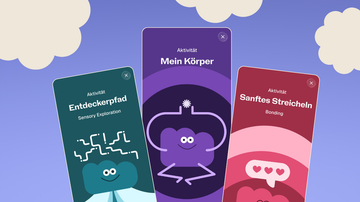
In der mo:mo App
Aktivitäten zur Selbstregulation für 12–18 Monate.
Wenn dein Kind häufig Wutanfälle bekommt, gibt es in der App 24 abgestimmte Aktivitäten, die helfen, Frustration körperlich zu kanalisieren — ohne dass es eine feste Methode braucht.
Aktivitäten ansehen