


Do you ever feel overwhelmed by the sheer amount of toys and wonder what your child actually needs? The good news: you probably already have plenty of treasures for creative play at home. This post shows you how everyday objects can become the most valuable tools for your child's development – sustainable, inexpensive and full of magic.
Why a wooden spoon is often more exciting than the most expensive toy
Have you ever watched your child abandon a new, flashing toy after a few minutes, only to become completely absorbed in an empty cardboard tube? That is no accident. Many toys have one fixed purpose. A toy car is for driving, a doll is for caring for. A simple object like a box or a piece of cloth, on the other hand, holds endless possibilities.
Educators call such open-ended materials „loose parts“. These are objects with no prescribed use that spark the imagination. Instead of following instructions, your child has to get creative: what can I do with this? How does it work? This kind of play is a genuine workout for the brain. It builds problem-solving skills, imagination and confidence. Sources such as Germany's Federal Centre for Health Education also highlight the high play value of everyday materials, because they direct a child's curiosity towards the real world.
5 simple ideas you can try straight away
You don't need to be a craft expert to get creative. It is about giving your child the tools and watching what happens. Here are a few tried-and-tested ideas that need very little preparation.
1. The treasure box from the kitchen
Feeling: The kitchen is often the heart of the home, and for children a place full of fascinating things.
Fact: Handling safe kitchen utensils such as whisks, wooden spoons or plastic bowls trains both fine and gross motor skills.
Action: Put together a box of safe kitchen items. Your child can empty it, fill it, stack things or drum with them. Make sure you only use objects that are big enough not to be swallowed and have no sharp edges.
To go with this, the mo:mo app offers plenty of activities for every age.
2. The cardboard box world
Feeling: An empty box is rubbish to an adult, but a blank canvas to a child.
Fact: Through role play with a box, your child processes experiences and develops social and language skills.
Action: Give your child a large, clean cardboard box. It can be a house, a car, a cave or a spaceship. You can cut doors and windows into it together or paint it. Even climbing inside and hiding is a huge adventure.
3. Sensory bottles for little explorers
Feeling: Babies and toddlers love shaking things, watching them and listening to the sounds they make.
Fact: Sensory experiences are the foundation of learning in the first years of life. They help the brain build important connections.
Action: Fill an empty, securely sealable plastic bottle with rice, lentils, water and glitter, or small colourful buttons. Seal the lid absolutely securely (hot glue works best). Your child now has a fascinating toy for the eyes and ears.
4. Collecting and sorting natural materials
Feeling: A walk outdoors can quickly get boring, but as a treasure hunt it becomes an adventure.
Fact: Collecting and sorting leaves, stones or sticks sharpens your child's perception of shapes, colours and textures.
Action: Take a bag along on your next walk and collect whatever nature offers. Back home you can sort the treasures by size, colour or type, or arrange them into a small work of art.

5. Fabric scraps and the magic of cloths
Feeling: Sometimes all it takes is a simple piece of cloth to step into another world.
Fact: Playing with cloths supports symbolic thinking – a cloth can be a cape, a blanket for a doll or the roof of a house.
Action: Give your child different fabric scraps or thin scarves. They can dress up, build dens, tuck dolls in or simply explore the different textures. The classic game of peekaboo is especially lovely with a cloth.
A moment for the family: sharing & remembering safely
These small, creative moments of play are priceless. Capture them and share them safely with the people you love. With the Family Account in the mo:mo app you can collect these precious memories in a protected place, without having to post them on public platforms. The result is a private chronicle of your child's discoveries.
Still wondering how to support your child's creativity in a targeted way? In the mo:mo app you will find over 650 development-boosting activities, and you can put your questions straight to our expert team with the Ask mo:mo feature. You can find further reading in the blog post by our mo:mo expert Dominique Merz: independence, creativity and confidence – why free play is so valuable.
PS: If you are looking for the perfect way into the world of playful learning, the Starter Set is ideal. It combines full access to the mo:mo app with an expert-developed physical product that stimulates your child's senses and motor skills.
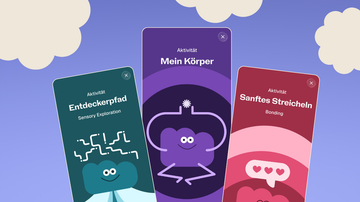
In der mo:mo App
Aktivitäten zur Selbstregulation für 12–18 Monate.
Wenn dein Kind häufig Wutanfälle bekommt, gibt es in der App 24 abgestimmte Aktivitäten, die helfen, Frustration körperlich zu kanalisieren — ohne dass es eine feste Methode braucht.
Aktivitäten ansehen